 ×
×


Chinese APT held near RMB 595,000 a tonne this week while the same product in Europe converted to roughly RMB 1.75 million. At home, tungsten has now given back every gain it made in 2026. Abroad, US cutting-tool shipments just set an all-time monthly record — and the industry's own leadership is openly pointing buyers toward alternatives to solid carbide.
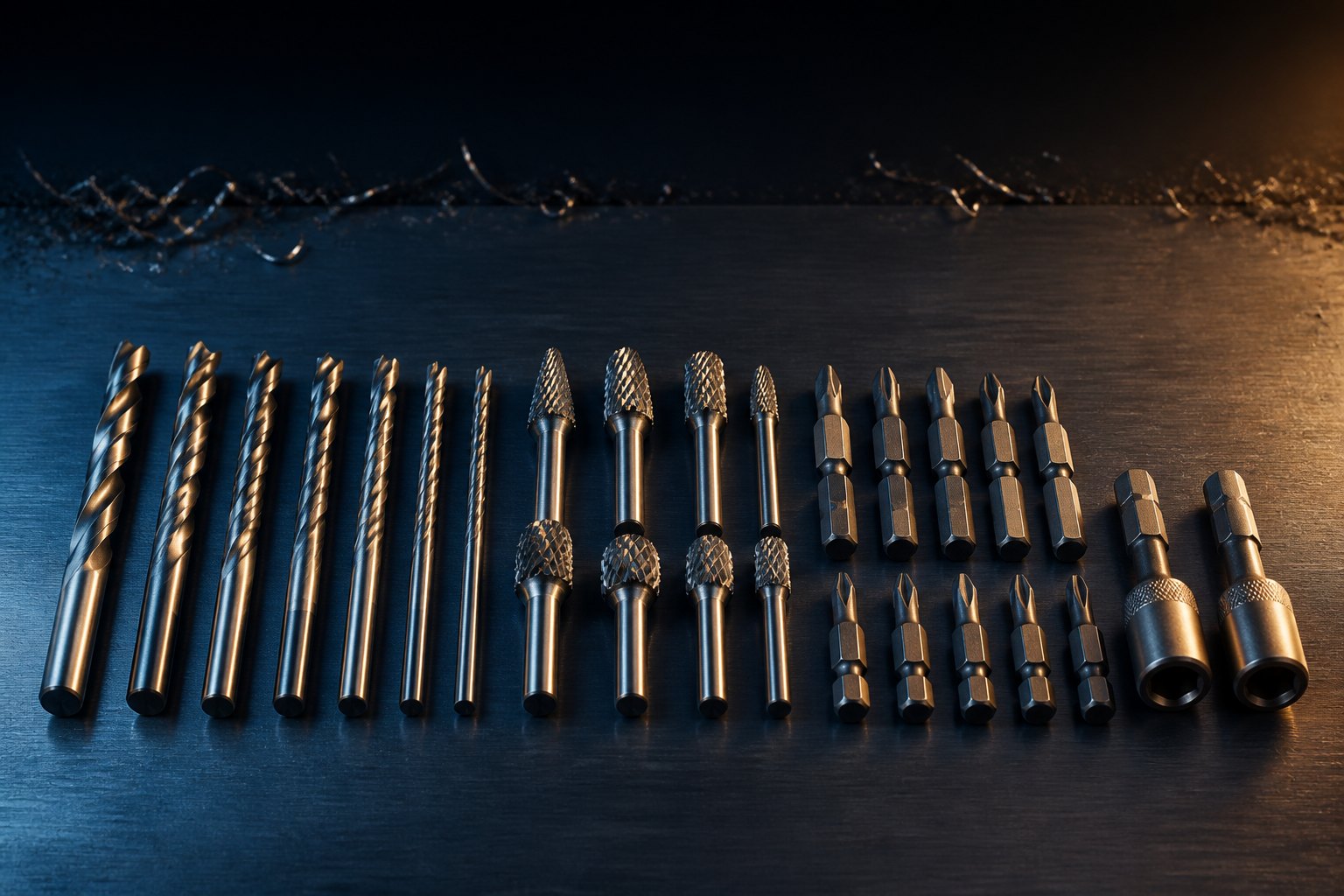
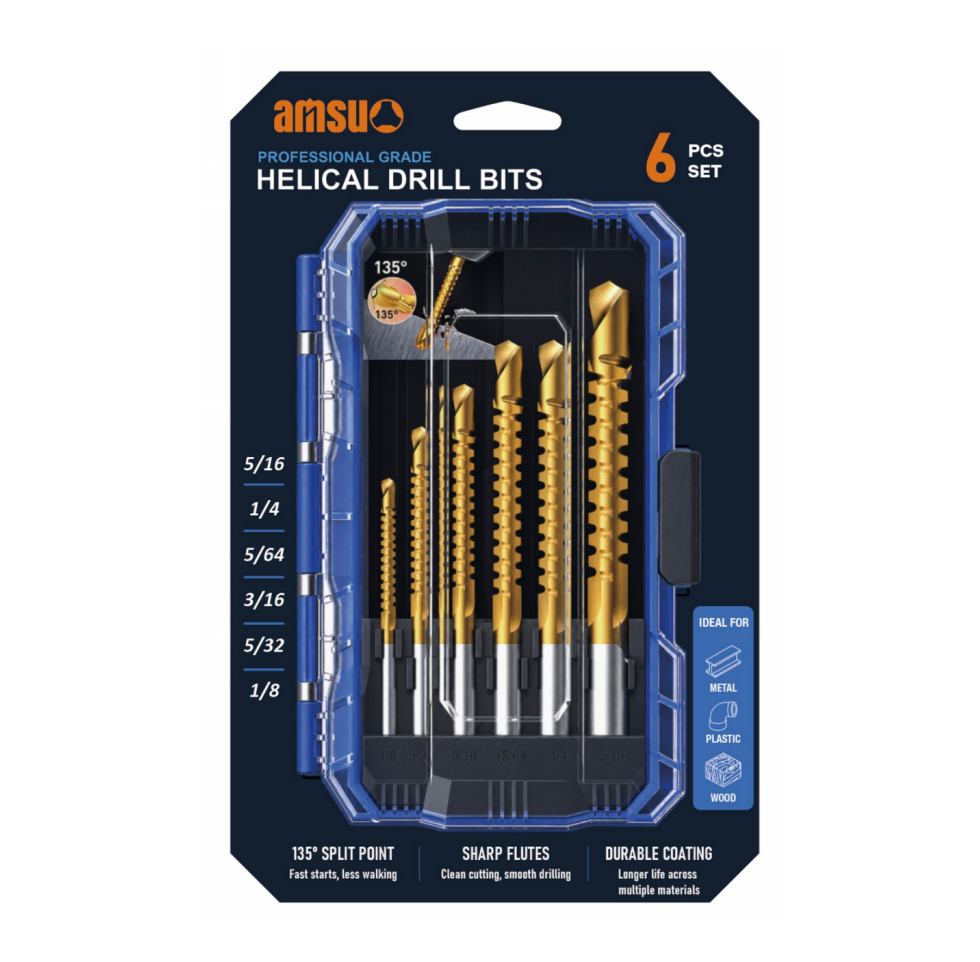
A catalogue under cost pressure: the accessories end of the market absorbs raw-material swings differently from solid tooling. Image: amsuo.
On 15 September, Chinatungsten Online assessed Chinese domestic APT at RMB 590,000–600,000 per tonne. The European assessment for the same intermediate stood at USD 2,900–3,000 per mtu — which, converted at prevailing rates, is RMB 1.722–1.782 million per tonne. That is a spread of more than RMB 1 million on a single tonne of the same chemical, as reported by 21st Century Business Herald on 15 September.
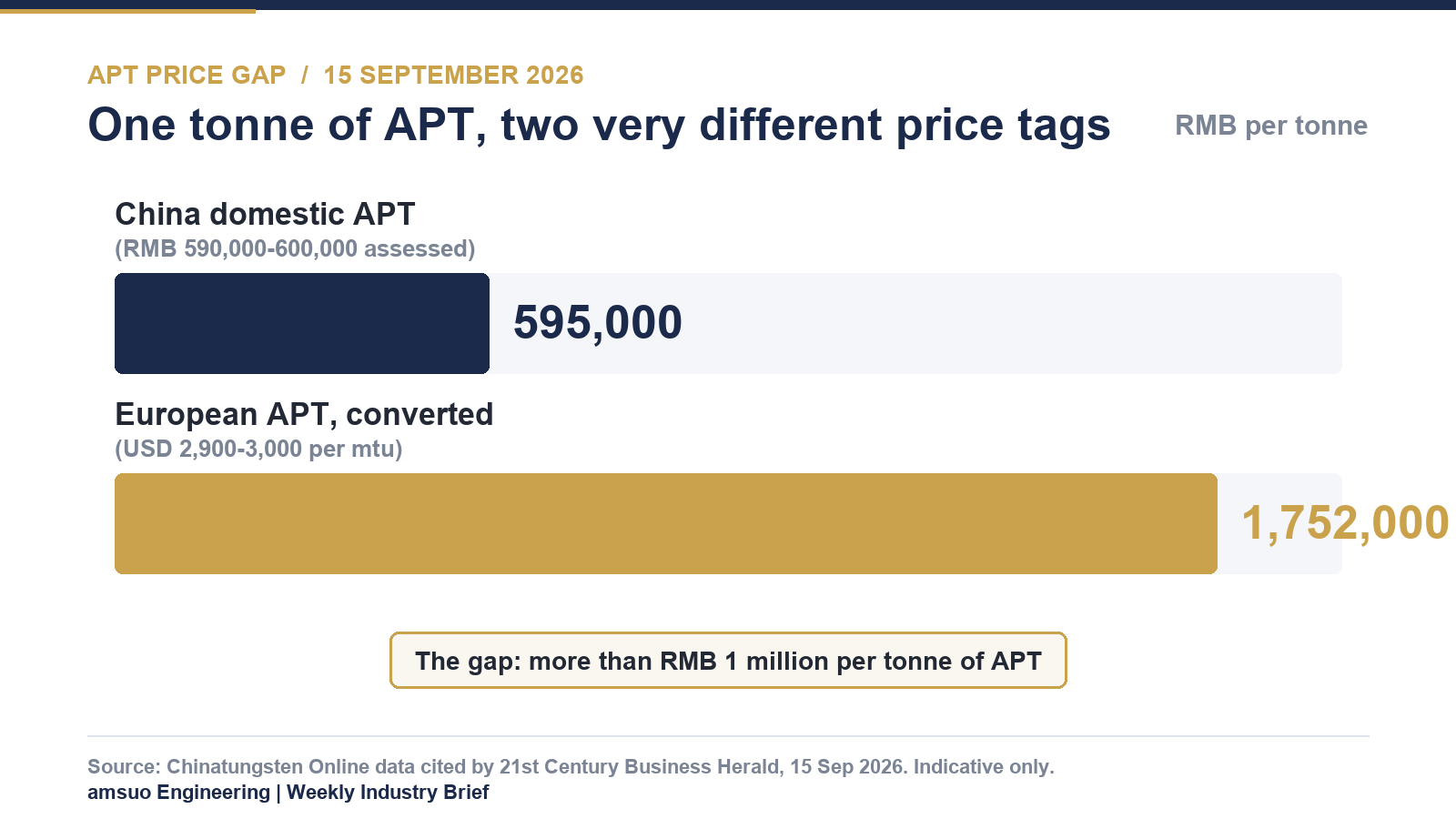
Indicative comparison of assessed APT prices, 15 September 2026. Chart: amsuo, from Chinatungsten Online data cited by 21st Century Business Herald.
The divergence is not a rounding error and it is not temporary. The same report puts European APT roughly 794% above its level in early 2025. Two markets that used to move together are now pricing the same material off two different sets of fundamentals.
The supply map changed on both sides at once. On the export side, China's controls have moved from a pricing question to a permission question: after the 2025 expansion of tungsten-related export controls, January 2026 brought tightened dual-use measures toward Japan, and Japanese tungsten powder imports fell sharply as a result, with two of the world's larger tungsten hexafluoride producers reporting first-half output cuts on feedstock problems.
Producing regions responded in kind. Zimbabwe has suspended tungsten exports in all forms, following its May 2026 listing of tungsten as a critical mineral. Vietnam's Ministry of Industry and Trade has proposed removing tungsten from the list of minerals eligible for export. In the United Kingdom, the National Wealth Fund announced in late August an investment of up to GBP 71 million in Tungsten West to support restarting the Hemerdon tungsten-tin mine in Devon.
Inside China the constraint is administrative as much as geological: concentrate mining runs under an annual quota set by the Ministry of Natural Resources, and output has trended down year on year. Analysts cited in the same report put China's 2025 tungsten output at 67,000 tonnes, about 78.7% of global supply, and note that new overseas projects are unlikely to add meaningful near-term volume.

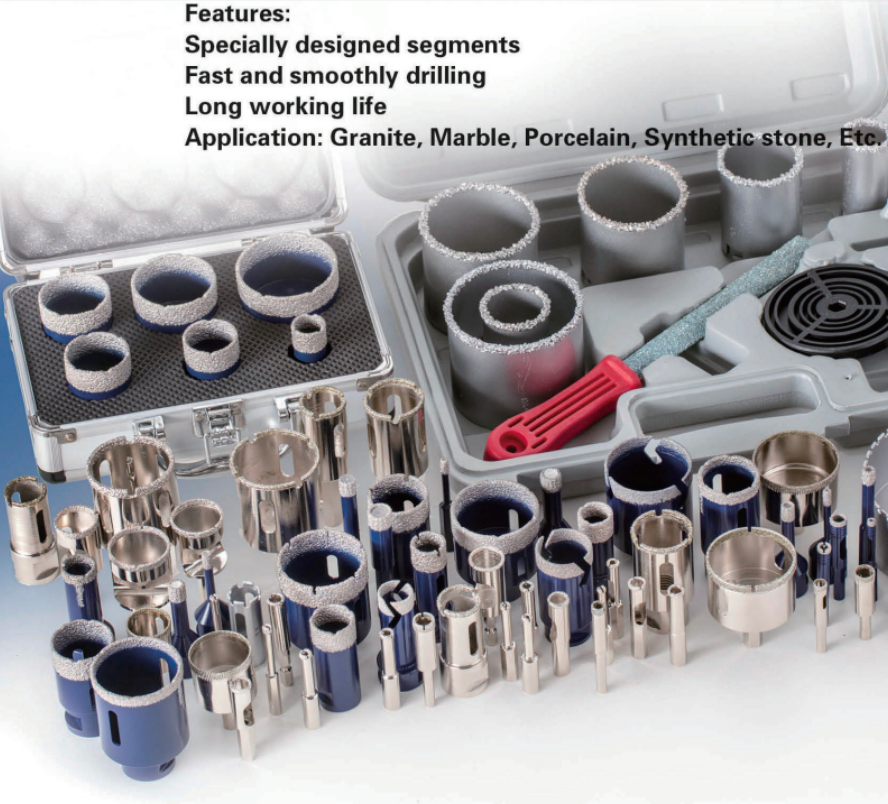
Carbide powder — the intermediate where a domestic price and an export price are now separated by geography as much as by cost. Image: amsuo.
The domestic number has a story of its own. Chinese APT opened 2026 at about RMB 670,000 per tonne, peaked in March at roughly RMB 1.52 million, and has since retraced to about RMB 595,000 — a full round trip that has erased the entire year's gain.
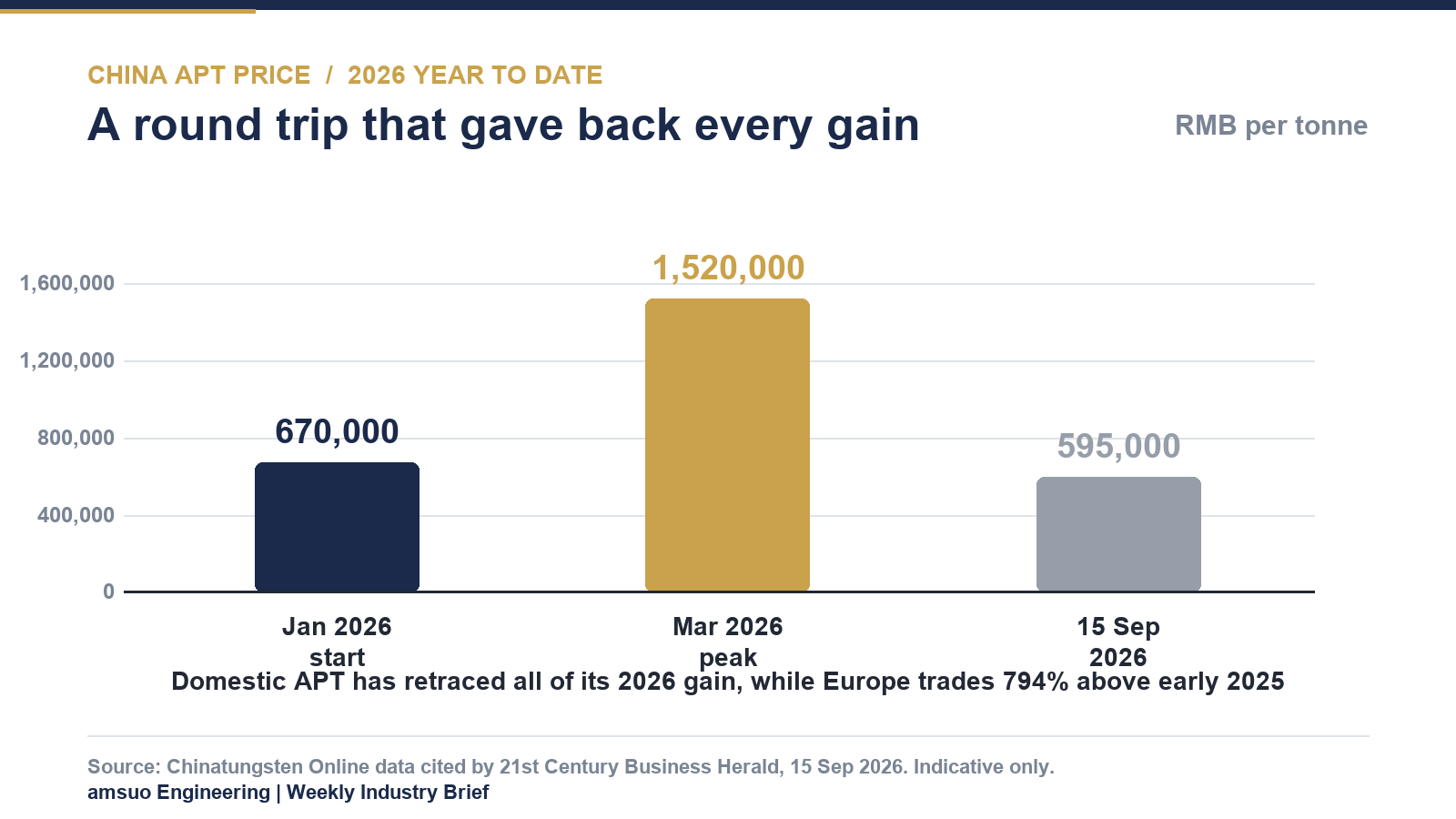
China domestic APT, 2026 year to date. Chart: amsuo, from Chinatungsten Online data cited by 21st Century Business Herald, 15 September 2026.
The Ganzhou Tungsten Industry Association's September outlook describes a market that has stopped falling but is not recovering: 55% black tungsten concentrate at RMB 413,000 per standard tonne, APT at RMB 600,000, and medium-grain tungsten powder at RMB 930 per kilogram. Chinatungsten's own read for the week was narrow-range consolidation, with both sides waiting for downstream restocking and for major producers' second-half contract prices.
Against that quiet domestic picture, US cutting-tool consumption set a record. Shipments totalled USD 278.1 million in July 2026 — up 2.8% on June and 29% above July 2025 — the highest monthly total ever recorded, according to the Cutting Tool Market Report published by AMT and the U.S. Cutting Tool Institute on 16 September. Year-to-date shipments reached USD 1.75 billion, up 20.7%. Unit shipments were flat month on month, which means the increase is value, not volume.
The report's own commentary explains why. AMT's Cutting Tool Product Group chairman, Jack Burley, attributed the value growth partly to the "carbide crisis" having pushed user costs up by double digits, most notably on larger tools — and said he expects strong interest at IMTS in alternative solutions to solid carbide cutting tools, such as replaceable carbide heads, as buyers look to control spend. ITR Economics' Michelle Kocses added the counterweight: the growth is real but uneven — automotive-type markets stagnant, high-tech and defence booming, and the durable-goods inventory cycle possibly turning down in 2027.
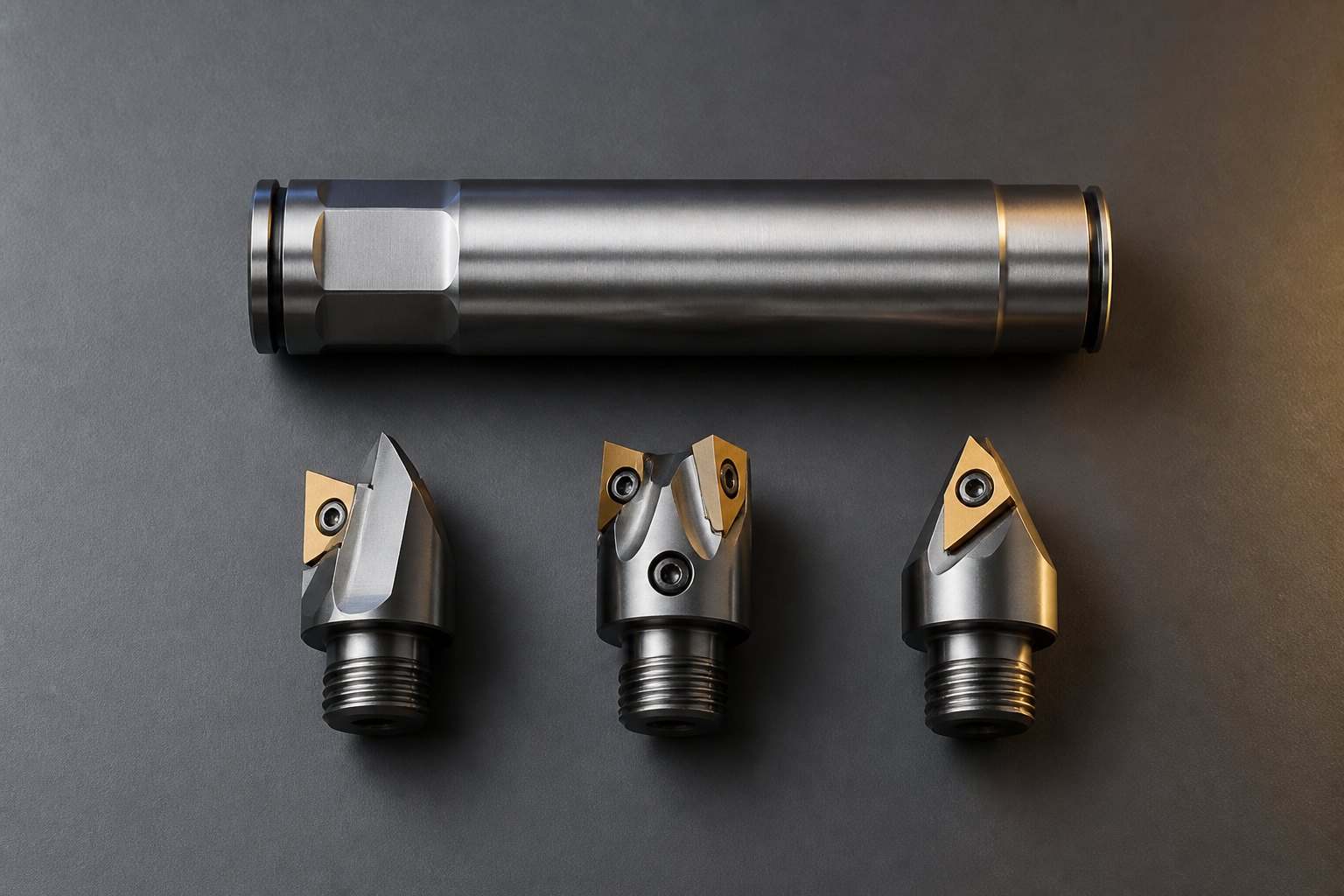
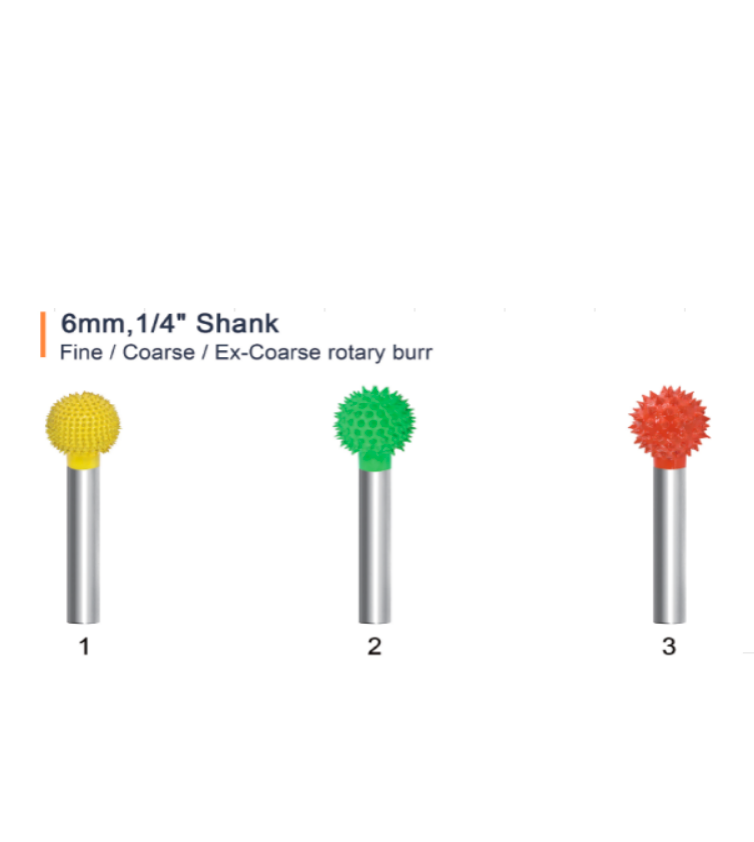
Replaceable heads, resharpening and geometry are moving from cost-saving ideas to mainstream buying criteria. Image: amsuo.
| Marker | Level | Dated | Source |
| APT, China domestic | RMB 590,000–600,000 / tonne | 15 Sep 2026 | Chinatungsten Online, cited by 21st Century Business Herald |
| APT, Europe (converted) | USD 2,900–3,000 / mtu ≈ RMB 1.722–1.782 m / tonne | 15 Sep 2026 | Chinatungsten Online, cited by 21st Century Business Herald |
| China APT, 2026 range | RMB 670,000 (Jan) → RMB 1.52 m (Mar peak) → ~RMB 595,000 now | 15 Sep 2026 | Chinatungsten Online, cited by 21st Century Business Herald |
| Ganzhou Association September outlook | 55% concentrate RMB 413,000 / std t; APT RMB 600,000 / t; medium-grain powder RMB 930 / kg | Sep 2026 | Ganzhou Tungsten Industry Association, via Mysteel |
| US cutting-tool shipments, July 2026 | USD 278.1 m, +2.8% MoM, +29% YoY; YTD USD 1.75 bn, +20.7% | 16 Sep 2026 | AMT / USCTI Cutting Tool Market Report |
| China share of global tungsten output | 67,000 t in 2025, about 78.7% of supply | 2025 data, cited Sep 2026 | USGS data cited by Guojin Securities |
1. "Alternatives to solid carbide" is now a mainstream brief, not a downgrade. When the chairman of AMT's cutting-tool group says buyers will be shopping for replaceable heads at IMTS, geometry, resharpening and modular systems stop being cost compromises. For a catalogue built on burrs, drills, sockets and bits, the opportunity is to sell cost per hole — not the price of the tool on the line.
2. Two price books mean two quoting disciplines. With domestic and export APT more than RMB 1 million apart, a single internal cost assumption will be wrong for one of the two, and export quotations carry a licensing dimension that domestic ones do not. Validity windows should be short enough to survive a market that moved 127% one way and back within nine months.
3. Documentation keeps appreciating. Export controls, critical-mineral designations and origin-based rules are being written into procurement requirements across Western markets. Material certification and traceability are increasingly the first filter a serious buyer applies — before price. Suppliers who can answer those questions cleanly move to the front of the queue.

Two price books, two planning cycles: inventory strategy now has to be set per market, not per product. Image: amsuo.
Our working position for the coming weeks: keep quotation validity short and material pass-through visible, and keep the catalogue broad enough that a customer is never forced into a solid carbide tool where a replaceable head, a resharpened tool or a different geometry would solve the same job for less. The gap between the domestic and the export price of the same intermediate is not something a supplier can smooth away — but it is something a buyer can be helped through, and that is a more durable reason to be chosen than a discount.
Compiled by amsuo Engineering from the public sources listed below. All figures are attributed to their publishers and are indicative only. Nothing in this brief constitutes a price quotation, offer or commitment; amsuo quotations are issued separately against confirmed specifications, quantities and delivery terms.
 Hot News
2026-09-18
2026-09-12
2026-09-11
2026-09-10
2026-04-03
2026-04-02
Copyright © 2026 Amsuo Technology Limited. All rights reserved — Privacy Policy
 EN
EN